Choosing the right Atrial Fibrillation Detection Wearable supplier takes more than comparing product photos or promised features. A polished screen cannot prove reliable rhythm detection. Buyers should examine the sensing method, validation evidence, comfort, battery life, data handling, and clinical support. Small details matter. Does the device record an ECG, or only flag irregular pulse patterns? Can users export a clear report for a clinician? These questions help separate practical tools from attractive brochures.
Evidence deserves close attention. In the Apple Heart Study, cardiologist and researcher Dr. Mintu Turakhia and colleagues reported: “Among participants who received an irregular pulse notification, atrial fibrillation was present on subsequent ECG patch monitoring in 34%.” That finding shows why an alert should prompt appropriate follow-up, not be treated as a diagnosis. Supplier claims should be checked against published studies and the exact device model being offered. Similar-looking products may use different sensors and algorithms.
This outline compares suppliers through a buyer’s lens: detection approach, clinical evidence, user experience, integration, and after-sales service. A device must work beyond a quiet demonstration room. It should remain comfortable during daily routines and provide understandable results when an alert appears. Yet no single checklist removes every uncertainty; performance can vary across users and settings. That deserves honest scrutiny. The strongest suppliers explain both what their wearables can do and where their limits remain.
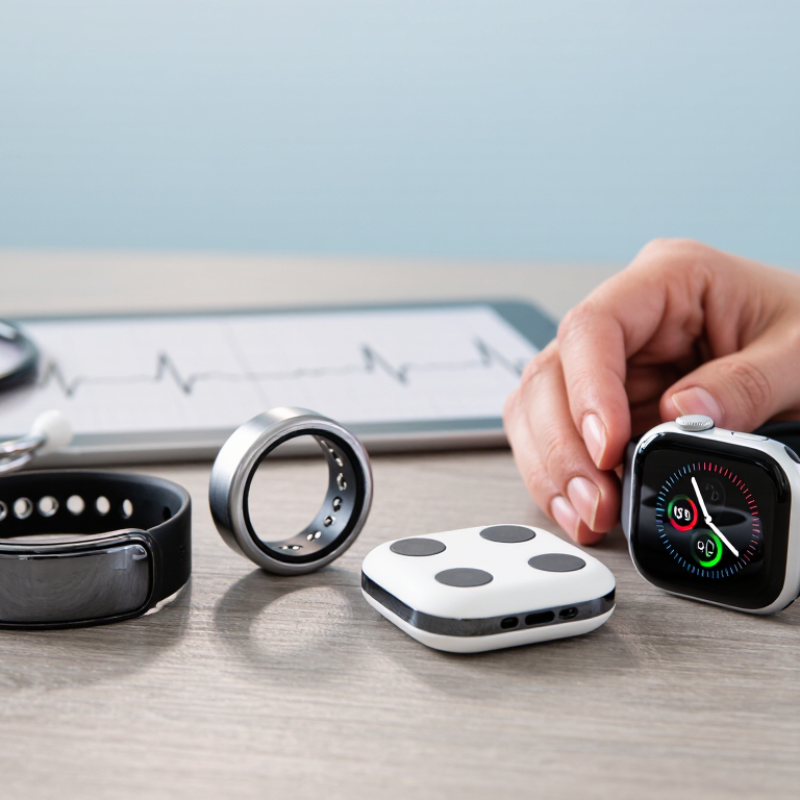
An atrial fibrillation (AF) wearable looks for an irregular heart rhythm, but different devices measure different signals. Optical sensors use light to track pulse patterns through the skin. Single-lead ECG devices record electrical activity when the wearer touches an electrode. A pulse alert is not a diagnosis. False alarms happen.
A 2019 smartwatch study published in the New England Journal of Medicine enrolled 419,297 people. About 0.52% received an irregular-pulse notification. Among participants who returned ECG patches, the notification’s positive predictive value was 84% during simultaneous monitoring. This figure describes a specific study, not the performance every device can promise. The 2023 ACC/AHA/ACCP/HRS guideline says suspected AF should be confirmed by a clinician reviewing an ECG tracing.
When comparing wearables, check whether they save ECG recordings for review, explain how alerts are generated, and state known limitations. A loose strap, movement, or poor skin contact can affect readings. So can brief or infrequent episodes that occur when the device is not being worn. Useful details matter: Can the user export a clear tracing? Does the app show the time of an alert? These features support follow-up, but they do not replace clinical assessment. One point is easy to overlook: more alerts do not automatically mean better detection.
Wearables usually screen for atrial fibrillation in two ways. Optical sensors shine light into the wrist and measure changing blood volume, producing a pulse signal called photoplethysmography. Software checks whether intervals between beats look unusually irregular. This can happen quietly in the background. But arm movement, loose straps, cold skin, and premature beats can confuse the signal.
A wrist alert is a prompt to check, not a diagnosis.
Some devices also record a single-lead electrocardiogram when a person touches an electrode. That tracing captures the heart’s electrical activity and can help clinicians assess an alert. In a 2019 New England Journal of Medicine study of 419,297 participants, 0.52% received an irregular-pulse notification. Among notified participants who later returned ECG patches, atrial fibrillation was found in 34%; when alerts coincided with patch recordings, the positive predictive value was 0.84. These figures describe a study population, not every wearer.
Important distinction.
A normal reading also cannot rule out intermittent episodes. In practice, a clinician may review a saved tracing and request a medical-grade ECG or longer monitoring. The wrist is useful, but it is not a clinic. Motion artifacts remain frustrating, and detection quality depends on fit, skin contact, and how often the device samples.
China’s atrial fibrillation wearable supplier landscape spans device makers, electronics manufacturers, and firms providing sensors, software, or contract production. Capabilities vary: one supplier may build wrist-worn photoplethysmography devices, while another integrates single-lead ECG electrodes into a handheld or wearable form. GBD 2019 estimated 59.7 million people worldwide were living with atrial fibrillation or flutter. This is a measure of health burden, not a forecast of wearable sales. Buyers should examine production capacity, sensor consistency, data security, and the supplier’s ability to support repeatable testing. Small details matter. Ask how readings perform during movement, perspiration, and loose device contact.
Clinical claims need particular care. The 2024 European Society of Cardiology guidelines describe ECG documentation as central to confirming atrial fibrillation; a pulse irregularity alert alone is not a diagnosis. Look for validation against an appropriate ECG reference, with participant numbers, recording conditions, and error rates clearly reported. Request evidence across age groups and skin tones, not only a polished demonstration. Also check whether the supplier provides traceable quality records and change control when hardware or algorithms are updated. Gaps happen. Even a capable manufacturer may have limited clinical evidence, so buyers should distinguish screening functions from diagnostic claims before selecting a supplier.
Evaluate clinical evidence before comparing prices or product specifications. Ask whether testing used an ECG reference standard and included older adults, different skin tones, and everyday movement. For ECG-enabled devices, review signal-quality data and manufacturing controls, including traceability and documented quality procedures. A polished demonstration is not clinical proof.
The 2019 Apple Heart Study, published in the New England Journal of Medicine, enrolled more than 419,000 participants. About 0.5% received an irregular-pulse notification. Among participants with a subsequent ECG patch, the notification’s positive predictive value was 84%. These results describe that study population, not every wearable or user. Suppliers should provide their own validation results, explain limitations, and distinguish screening from diagnosis. No single metric tells the whole story.
Tips: Request the study protocol, sample size, and error rates before signing. Check how software updates and data security are managed. If answers are vague, pause. Even capable manufacturers may have gaps; that deserves an honest conversation, not a sales promise.
When comparing atrial fibrillation detection wearables, treat certification as a starting point, not proof of clinical performance. Ask suppliers for quality-system documentation, risk-management records, and software lifecycle controls, such as ISO 13485, ISO 14971, and IEC 62304 where applicable. These standards address manufacturing and safety processes; they do not establish that an algorithm detects AF accurately in your intended population. A tidy certificate folder can still hide a weak workflow.
Clinical evidence should match the device’s actual use: wrist position, recording duration, skin tone representation, motion conditions, and the intended patient group. A 2019 NEJM study involving 419,297 participants reported that 0.52% received an irregular-pulse notification. Among participants with a notification and a simultaneous ECG patch recording, the notification’s positive predictive value for AF was 0.84. That result is specific to the study setup, not a guarantee for every wearable or care setting. The 2023 ACC/AHA/ACCP/HRS guideline also emphasizes clinician review of ECG signals to establish an initial diagnosis. Alerts need confirmation.
For procurement, request the full validation protocol, subgroup results, false-alert rates, and evidence from independent investigators. Check whether the supplier provides secure data export, clear alert escalation steps, staff training, and ongoing software-change notices. Pilot the system with real users before a large order. It takes time. Compare missed cases and unnecessary follow-ups, not just dashboard accuracy. Even a careful pilot can miss problems that appear later.
Supplier-neutral procurement comparison framework. Verify each item against the exact device model, intended use, target market, and current documentation; requirements vary by product and jurisdiction.
| Evaluation dimension | Evidence to request | What credible evidence should establish | Buyer verification / procurement consideration |
|---|---|---|---|
| Regulatory status and intended use | Device registration or market authorization documents, product label, instructions for use, and the stated intended purpose for the exact model. | Authorization and intended-use claims are specific to the device and market. In China, confirm applicable NMPA requirements for the product; classification and pathway depend on intended use and device characteristics. | Match model numbers, manufacturer details, software version, and claims across documents. Do not treat a registration, listing, or export document as approval for every market or every diagnostic claim. |
| Quality management system | Current ISO 13485 certificate, certificate scope, issuing certification body, and latest audit or surveillance status. | The certificate should cover the relevant legal manufacturer, sites, and activities, such as design or manufacture of medical devices. ISO 13485 is a quality-system standard, not product approval. | Check validity and scope directly with the issuer or accreditation records where available. Confirm which entity is responsible for design, manufacturing, release, and post-market handling. |
| Clinical validation of AF detection | Full study report or peer-reviewed publication for the same device and algorithm version, including protocol, population, reference method, analysis plan, and conflicts of interest. | Study results should report sensitivity and specificity with denominators and confidence intervals, describe the reference standard and adjudication, and explain missing or uninterpretable recordings. Performance should be evaluated in a population relevant to the intended users. | Check whether testing was prospective, whether data were independent of algorithm development, and whether results apply to the exact device, firmware, and software version being purchased. A press release or summary alone is insufficient. |
| Measurement method and intended role | Technical description of ECG, photoplethysmography (PPG), or combined sensing; recording duration; signal-quality rules; and clinician review workflow. | PPG can identify pulse irregularity for screening but does not itself provide an ECG tracing. ECG-capable devices record electrical signals; the permitted clinical interpretation depends on the product’s authorization and labeling. | Clarify whether the product is intended for screening, rhythm monitoring, or diagnosis. Confirm how alerts are reviewed and communicated, and ensure product claims do not exceed authorized intended use. |
| Electrical safety and electromagnetic compatibility | Applicable test reports and declarations for the device configuration, charging equipment, and accessories. | Reports should identify the tested model and applicable standards. IEC 60601-1 and IEC 60601-1-2 may be relevant to medical electrical equipment, depending on device type and intended use; applicability should be confirmed for the product. | Request complete reports rather than a standards list alone. Confirm that changes to hardware, accessories, or manufacturing sites have not made the evidence outdated. |
| Software lifecycle and risk management | Software version history, development and verification records, risk-management documentation, change-control procedure, and algorithm update policy. | For applicable medical-device software, evidence may reference IEC 62304 and ISO 14971. The documentation should trace hazards, mitigations, verification, and release decisions for the supplied version. | Define how updates are approved, tested, distributed, and rolled back. Agree whether software or algorithm changes require buyer notification, revalidation, or regulatory review. |
| Biocompatibility and skin-contact materials | Materials list, skin-contact assessment, and applicable biocompatibility test reports for the finished device or relevant patient-contacting parts. | ISO 10993-based evaluation may be relevant for materials contacting the body; the required tests depend on contact type, duration, and device configuration. | Check that evidence covers the actual strap, electrode, adhesive, coating, and intended wear duration. Request change notification for material substitutions. |
| Data protection and cybersecurity | Data-flow diagram, encryption and access-control details, vulnerability-management process, retention and deletion policy, and hosting-location information. | Privacy and cybersecurity obligations depend on the markets and data involved. GDPR may apply to relevant EU processing; China’s PIPL may apply to covered personal-information processing in China. Neither should be represented as a product-quality certificate. | Confirm data ownership, user consent, cross-border transfers, breach notification, subcontractors, and account termination procedures in the contract. Ask for evidence supporting any security claims. |
| Manufacturing capability and traceability | Manufacturing-site details, production controls, lot and serial-number traceability, incoming inspection procedures, and change-control records. | Records should support identification of the device configuration and production lot, investigation of defects, and execution of corrective actions or recalls. | Audit the actual production site or use an independent audit where appropriate. Confirm which site and legal entity will manufacture and release the devices supplied under the contract. |
| Post-market support and vigilance | Complaint-handling procedure, adverse-event escalation process, field-safety-corrective-action process, and service-level commitments. | The supplier should have a documented process for investigating complaints, monitoring safety signals, and communicating field actions in applicable markets. | Set contractual timelines for safety notices, investigation responses, replacement units, and corrective actions. Identify the local authorized representative or responsible contact where required. |
| Commercial and supply continuity | Written quotation, model-specific bill of materials or configuration, warranty terms, production capacity statement, and lead-time assumptions. | Commercial terms should clearly identify included accessories, software services, support period, packaging, and any recurring fees. Capacity and lead time should be supported by a supply plan rather than an unsupported guarantee. | Request sample units for technical evaluation before volume orders. Define acceptance criteria, minimum order quantities, payment milestones, delivery terms, spare-parts availability, and remedies for nonconforming goods. |
| Supplier qualification outcome | Completed document checklist, sample-test results, audit findings, and a written gap-assessment record. | A qualified supplier should provide consistent, verifiable evidence for the exact product and intended market, with open gaps clearly identified and assigned corrective actions. | Decision rule Shortlist only after regulatory, clinical, quality, technical, and commercial evidence has been reviewed; do not rank suppliers solely by price, certificates, or headline accuracy claims. |
Optical sensors use light to track pulse patterns through the skin. ECG devices record electrical activity when the wearer touches an electrode. Neither alert alone confirms atrial fibrillation.
No. A clinician needs to review an ECG tracing to confirm suspected atrial fibrillation. Alerts can be wrong.
In one study, about 0.52% of 419,297 participants received an irregular-pulse notification. Among participants who returned ECG patches, the notification’s positive predictive value was 84% during simultaneous monitoring. That result applies to that study, not every device.
A loose strap, movement, perspiration, or poor skin contact may affect readings. Short episodes can also be missed if the device is not being worn. Small details matter.
Ask for validation against an appropriate ECG reference. Check participant numbers, recording conditions, and reported error rates. Evidence across age groups and skin tones is useful. A polished demonstration is not enough.
Check whether users can export a clear ECG tracing and see the alert time. Ask how alerts are generated and what limitations are known. More alerts do not automatically mean better detection.
Review sensor consistency, production capacity, and traceable quality records. Ask how hardware or algorithms are tested after changes. Gaps happen; documentation may still be limited.
No. ECG documentation is central to confirmation. Wearables may support screening and follow-up, but clinical assessment remains necessary. Easy to overlook.
This article explores how an Atrial Fibrillation Detection Wearable can help identify signs of irregular heart rhythms through technologies such as optical pulse sensors and, in some devices, electrocardiogram recording. It explains how these tools collect and interpret heart-rate data, deliver alerts, and support ongoing monitoring, while emphasizing that a wearable’s readings are not a substitute for professional diagnosis or medical care.
The article also reviews China’s supplier landscape and outlines practical ways to assess manufacturers, including product capabilities, manufacturing consistency, technical support, and suitability for the intended use. It highlights the importance of checking relevant certifications, reviewing clinical validation and performance evidence, and clarifying data handling, quality control, and procurement requirements. These considerations can help buyers compare suppliers carefully and select devices that meet their needs with appropriate evidence and dependable support.