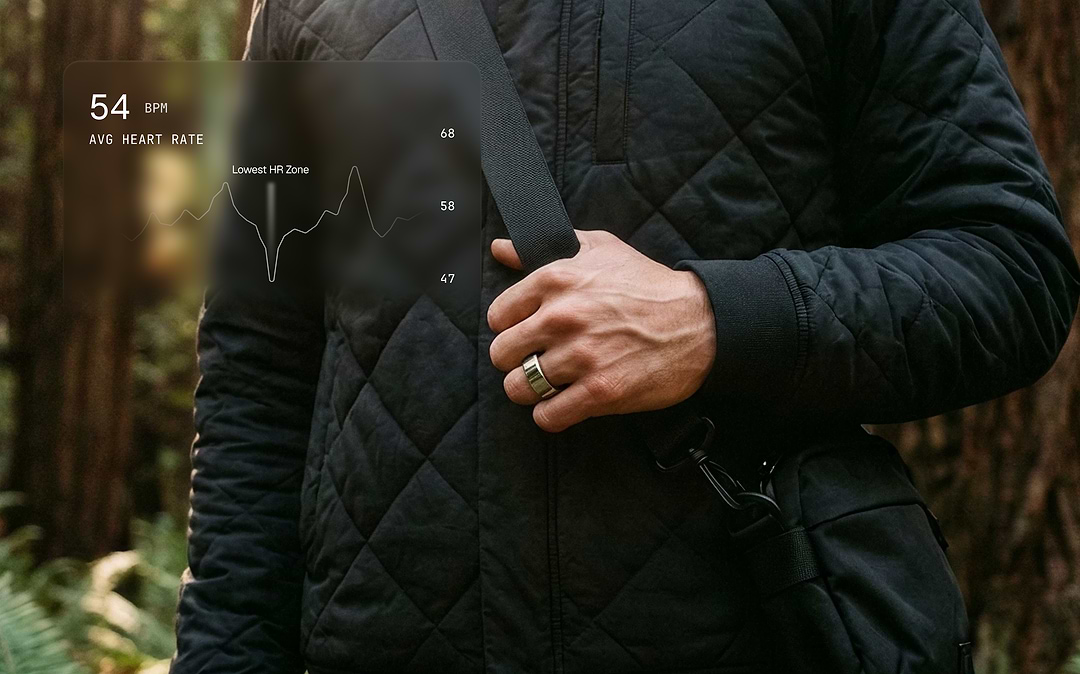
Stress Rhythm Monitoring represents a fundamental paradigm shift in continuous physiological surveillance. Unlike legacy spot-check heart rate monitors or intermittent consumer wearables, institutional Stress Rhythm Monitoring measures real-time fluctuations in the Autonomic Nervous System (ANS) across 24-hour circadian cycles. By combining high-frequency photoplethysmography (PPG) at the palmar digital arteries with continuous skin temperature gradient analysis and 6-axis accelerometry, enterprise health platforms can capture real-time Sympathetic Nervous System (SNS) activation versus Parasympathetic Nervous System (PNS) rebound.
The Physiological Advantage of Finger-Based Digital Sensing
For global procurement managers evaluating bio-monitoring hardware, sensor placement is the single critical variable governing data fidelity. The wrist presents significant optical monitoring challenges: thick epidermal layers, tendon motion artifacts, ambient light leakage, and low perfusion index (PI). In contrast, the palmar surface of the finger is innervated by dense digital micro-vascular networks supplied directly by the radial and ulnar arteries. The signal-to-noise ratio (SNR) recorded at the digital arterial level is up to 300% stronger than wrist-based optical sensors, enabling sub-millisecond Inter-Beat Interval (IBI) detection essential for calculating time-domain and frequency-domain Heart Rate Variability (HRV).
Time-Domain HRV Metrics
Monitors Root Mean Square of Successive Differences (RMSSD) and Standard Deviation of NN intervals (SDNN) continuously to map acute physiological recovery and cognitive fatigue thresholds.
Circadian Thermal Shift Correlation
Integrates dual skin-temperature sensors to detect micro-variations in peripheral vasoconstriction, correlating autonomic stress spikes with core body temperature fluctuations.
On-Chip Machine Learning Filter
Executes real-time signal processing directly on the ring dual-core processor to eliminate motion artifacts from manual labor, exercise, or transient hand movements.
By mapping these multi-parametric inputs into a continuous Stress Rhythm Index, procurement clients gain objective, quantifiable bio-visibility into workforce burnout risk, executive cognitive stamina, military operator readiness, and patient recovery trajectories. Ultrahuman’s proprietary algorithmic engine normalizes raw IBI data against individual baseline metrics, transforming raw signal noise into actionable operational intelligence.